What Is Agentic AI? (And Why Most Businesses Misunderstand It)
What Is Agentic AI? (And Why Most Businesses Misunderstand It)
Agentic AI is not just a chatbot. It refers to AI agents, autonomous AI systems, and AI workflow systems that can complete multi-step tasks with limited human input.
Most businesses misunderstand it because they focus on tools before strategy. Without clear direction, even advanced intelligent automation will amplify the wrong process.
In practice, Agentic AI shows up in CRM automation, lead generation, content systems, workflow management, onboarding, inbox handling, and customer service triage.
The highest-performing approach is still human-led. I use the First 10% and Last 10% Rule to set direction, review outcomes, and keep brand integrity intact.
What Is Agentic AI?
Agentic AI refers to autonomous AI systems and AI agents that can complete multi-step tasks, make decisions within defined boundaries, and adapt based on feedback with limited human input. In practice, this means AI can begin to execute entire workflows rather than just assisting with isolated tasks.
Introduction
Agentic AI is a term that is currently dominating the corridors of Gartner and McKinsey, yet it remains one of the most misunderstood concepts in the modern business landscape. If you are an SME owner looking to scale towards that 7 figure milestone, you’ve likely encountered dozens of articles leaning heavily into technical jargon, enterprise-scale use cases, or abstract descriptions of autonomous systems. While those definitions are not technically wrong, they often miss the mark for owners trying to build a business that grows cleanly, profitably, and without more chaos.
For many small business owners, the issue isn't a lack of interest; it’s that the concept feels either too advanced, too overwhelming, or disconnected from day-to-day operations. I’ve watched countless SME leaders who assume Agentic AI is something they will “look into later,” while others quietly worry it will compromise their brand's authenticity, control, or even their foundational values.
Consequently, most founder/leaders sit in one of two camps: they either avoid it entirely, or they jump in without a cohesive strategy and hope the technology solves their operational drag. Both approaches are costly. The truth is far simpler: this isn't a futuristic idea waiting to arrive: it is already embedded into the systems we use every day. The real shift isn't the technology itself; it is the clarity with which a business owner understands their own processes before applying these force multipliers.
What Is Agentic AI and How Does It Work?
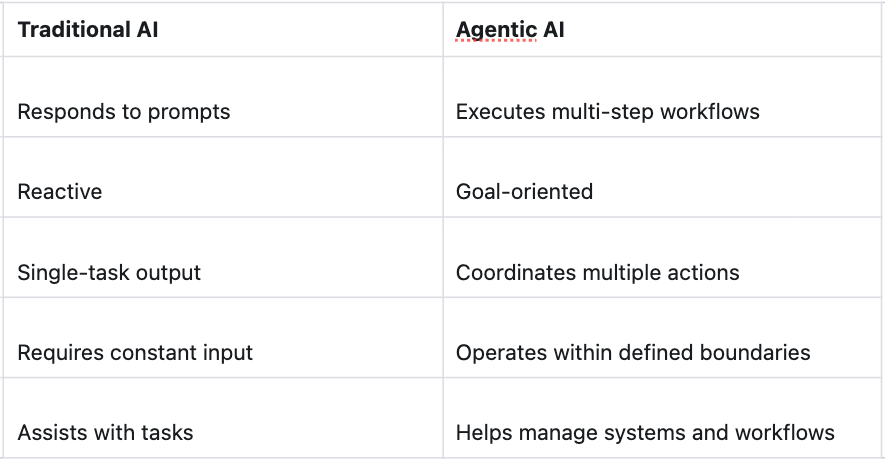
In simple terms, Agentic AI refers to systems that go far beyond simple, prompt-and-response interactions. Unlike traditional generative models that wait for your specific instruction at every turn, agentic systems are designed to work through multi-step tasks, make decisions within defined boundaries, and adjust their course based on feedback.
Think of it as the difference between a calculator and a digital project manager. A calculator waits for your input; a project manager understands the objective, coordinates the resources, and ensures the milestone is met. However, the most critical misunderstanding I see is the belief that this technology replaces the need for strategic thinking. It does not. In fact, it amplifies it.
If a business lacks a clear direction, a defined audience, or a structured offer, then Agentic AI will not fix the problem. It will simply accelerate the confusion. But for the leader who has invested in clarity and a strong go-to-market approach, these systems become a force multiplier that removes repetitive admin and increases high-value output significantly.
How Agentic AI Works
1. Perception
AI gathers information from inputs and systems.
2. Reasoning
The system evaluates goals and possible actions.
3. Action
The AI executes tasks across workflows.
4. Feedback & Learning
The system adapts based on outcomes and rules.

To make this more practical, think of it like using a GPS on your phone:
Perception: The GPS "sees" your current location and the traffic congestion on the roads ahead.
Reasoning: It evaluates every possible route to your destination and chooses the fastest one based on the current conditions.
Action: It gives you the direction: "In 200 meters, turn left."
Feedback & Learning: You miss the turn. The system doesn’t just stop; it immediately recalculates a new path based on your updated position to get you back on track.
Benefits of Agentic AI for Businesses
Reduced repetitive admin: Freeing up your team for high-level work.
Faster response times: Engaging leads and customers in seconds, not hours.
Improved operational consistency: Ensuring processes are followed perfectly every time.
Better lead management: No prospect falls through the cracks.
Increased scalability: Growth without a proportional increase in overhead.
Reduced workflow bottlenecks: Eliminating manual friction in delivery.
More strategic time allocation: Staying in your 'zone of genius.'
Practical Examples: Industry Insights
To make this tangible, let’s look at how these high-leverage systems translate into real-world operations for service-led organisations.
Agentic AI in a Construction Firm
Automated Project Oversight: Instead of manual site reporting, an autonomous system can aggregate subcontractor updates, track material delivery logs, and flag potential delays before they impact the schedule.
Instant Lead Qualification: When a potential renovation client reaches out via your website, an AI agent (think a chatbot on your website) engages them instantly, qualifies their budget and timeline, and schedules a site visit—all while your team is on-site.
Safety & Compliance Consistency: AI agents can ensure that every safety checklist is completed and uploaded by the team before the next phase of work is unlocked in the project management system.
Agentic AI in an Accounting Practice
Zero-Touch Data Processing: Systems can autonomously extract data from bank feeds and digital receipts, categorising transactions and flagging anomalies for human review during the 'Last 10%.'
24/7 Client Advisory Support: An AI agent can handle routine enquiries about tax deadlines, document status, or basic compliance questions, ensuring clients receive immediate answers without interrupting your deep-focus work.
High-Value Onboarding: When a new client joins, the system autonomously triggers the engagement letter, requests the necessary financial historical data, and sets up the internal folder structure, allowing you to focus on the initial strategic consultation.
Agentic AI vs Traditional AI Tools

Why the Real Problem Isn’t the Technology
The biggest misconception I encounter is the idea that Agentic AI is the hurdle business owners need to "figure out."
In reality, most high-level operators are already interacting with these systems daily. Recommendation engines (think Google or even Netflix), search rankings, and sophisticated social media algorithms (the scroll that's perfectly tailored to you) are all shaping our professional decisions in the background.
The paradigm shift we are witnessing now is that these capabilities are finally becoming accessible to us directly. Instead of large tech platforms holding all the keys, we can now build internal versions of these systems to handle our specific needs: inbox communication, lead generation, content distribution, and complex CRM workflows.
But this shift doesn't automatically create a competitive advantage. It simply raises the baseline for what "standard" operations look like. The real advantage comes from how you integrate these tools to stay in your zone of genius. If you want a practical view of where this starts, my article on AI Automation Tools That Saved My Sanity breaks down how the right systems can remove unnecessary pressure without adding more complexity.
How Agentic AI Shows Up in High-Level Operations
In a professional context, Agentic AI isn’t a single piece of software; it’s a collection of workflows that handle the heavy lifting across your organisation. These AI agents and autonomous AI systems can be configured to complete multi-step work across marketing, operations, and service delivery while still working within clear human direction.
🤖 Agentic AI for CRM Automation
One of the clearest examples is CRM (Customer Relationship Management - like a unicorn office manager/marketing manager/sales manager all rolled into one!)) automation.
Some AI CRM workflow systems can manage high-volume inbox communication, draft contextually relevant responses, update contact records, and autonomously schedule calendar links based on your availability. Instead of acting like a passive tool, the CRM system can move a lead or client through a process with far less manual effort.
🤖 Agentic AI for Lead Generation
Other systems focus on lead generation. They scan the digital landscape for potential prospects (like Stan from Marblism), analyse their needs, and prepare a structured outreach strategy. For my team, this has meant moving from manual research to high-level strategic oversight. Our case studies show that when you remove manual bottlenecks, you unlock the capacity to focus on the 10% of tasks that actually move the needle on revenue.
🤖 Agentic AI for Content Systems
Content systems are another prime example. They can generate authoritative blog posts, support internal linking for SEO performance, and maintain a consistent publishing cadence without requiring you to stare at a blank page. This kind of intelligent automation reduces execution overhead, but the strategic direction remains firmly in your hands.
🤖 Agentic AI for Workflow Automation
Beyond marketing, Agentic AI also supports workflow automation across the business. This can include task routing, follow-up reminders, approval pathways, and client delivery checkpoints. When these autonomous systems are designed well, they create consistency across the business and reduce the friction that often slows down growth.

Real-World Examples of Agentic AI in Business
The easiest way to understand Agentic AI is to look at practical application. In many service-based companies, AI agents are already being used behind the scenes to reduce repetitive admin and improve response times.
A common example is onboarding automation. Instead of manually sending each welcome email, contract, intake form, and calendar link, an AI workflow system can trigger each step in order, check for completion, and notify the right person if something is missing.
Email management is another strong use case. Rather than leaving your inbox to become a decision bottleneck, autonomous AI systems can sort messages by urgency, draft replies, route requests to the correct team member, and flag the messages that genuinely require your input. This is where intelligent automation becomes practical rather than theoretical.
Customer service triage is equally valuable. If a client submits a support request, the system can identify the issue type, send the right initial response, assign the conversation to the right workflow, and escalate complex cases when needed. That means your team spends less time sorting and more time solving. To ensure you aren't falling into common traps during this setup, check out my guide on 7 Mistakes You're Making with AI Tools for SMEs.
These examples matter because they show what Agentic AI actually is in business terms. It is not magic, and it is not leadership in a box. It is a structured way to deploy AI agents and automated decision-making inside repeatable processes that already matter to your growth.
The First 10 Percent and Last 10 Percent Rule
“AI should handle the busywork in the middle, but the vision at the start and the final touch still need you.”
One of the most important lessons I’ve learned in my journey from burnout to breakthrough is that Agentic AI does not remove the human element. In fact, it makes your clarity more vital than ever before. I follow a simple framework called the First 10% and Last 10% Rule.
The process begins with the business leader: you: defining the outcome with absolute precision (the First 10%). You set the parameters, the tone, and the strategic objective. The agentic system then executes the middle 80% of the operational work: the research, the drafting, the data processing. Finally, you return to review, refine, and approve the output (the Last 10%).
Most failures happen when either of these steps are neglected. If you don't provide clear direction, the AI produces generic noise. If you don't perform the final review, you risk losing the personal touch that builds trust with your clients. Your role shifts from "doer" to "architect," but your presence is still the soul of the business.
Why Some Businesses Fall Behind With Agentic AI
There are three predictable patterns I see when leaders attempt to implement Agentic AI without a proper blueprint.
The Strategy Gap: Using technology without clarity around your audience or positioning. The result is "faster failure": automated systems that push the wrong message to the wrong people.
The Avoidance Trap: Delaying adoption because the landscape feels overwhelming. This creates a widening gap between you and the competitors who are quietly building leverage.
Over-Automation: Attempting to delegate too much, too early, without oversight. This leads to broken customer experiences and a loss of brand integrity (aaaand this was (and sometimes still is!) meeee!)
A common mistake is assuming AI behaves like a fully mature executive from day one. It doesn’t. It behaves more like a high-potential new team member who requires onboarding, clear structure, and consistent supervision.
This is why a controlled, systematic implementation matters far more than just "buying more tools." If you're weighing up human support versus software leverage, Virtual Assistants Vs AI Tools will help you think through that decision more clearly.
Risks and Limitations of Agentic AI
While the potential is massive, high-level operators must be aware of the risks:
Poor strategic direction: Automating a broken process just breaks it faster.
Inaccurate outputs: Systems still require human 'Last 10%' review to ensure quality.
Over-automation: Losing the human connection that high-value clients value.
Weak oversight: Without clear boundaries, autonomous systems can drift.
Workflow dependency: Relying on tools without understanding the underlying logic.
Data & Privacy: Ensuring your implementation respects client confidentiality.
The Competitive Divide: Strategic Operators vs. Reactive Adopters
Over the next few years, the gap between businesses will widen significantly. However, it won't be between those who "have AI" and those who don't. It will be between the strategic operators and the reactive adopters.
The leaders who thrive will be those who have already done the foundational work. They understand their value proposition, they have a structured go-to-market approach, and they use Agentic AI as an amplifier for that direction. For them, technology is a tool for stewardship: a way to manage their resources, time, and impact with excellence.

The Deeper Resistance: A Kingdom Perspective
For many of us building a Kingdom-minded business, the resistance to AI isn’t just about tech: it’s often about integrity. We care deeply about authenticity and the human connection that lies at the heart of our service.
I believe technology itself is neutral; it simply reflects the intention of the user. When used poorly, it creates noise. When used with wisdom, it creates the leverage needed to fulfill a bigger mission.
Avoidance doesn't protect your values: it often limits your capacity to serve those you were meant to reach. The real risk isn't the tool; it's using it without discernment or ignoring it while others build the systems that will define the future of your industry.
Your Path to Implementation
If you are feeling the weight of the execution overhead, the first step isn't technical. It starts with clarity. Ask yourself: if I could wave a magic wand and achieve one meaningful outcome in my business this month, what would it be?
Once that is clear, the path to automation becomes a series of manageable milestones. Whether it's setting up your first sales funnel or automating your client onboarding, the goal is always the same: reclaiming your time to focus on what matters most.
For leaders ready to move from theory to execution, I cover these exact milestones and build your high-leverage roadmap during my Accelerator Workshop.
When Businesses Usually Need Agentic AI
Most businesses start exploring Agentic AI seriously when:
Growth creates operational bottlenecks.
Inboxes become unmanageable.
Lead follow-up becomes inconsistent.
Onboarding slows down delivery.
Content production becomes overwhelming.
This is usually the point where systems become more valuable than additional hustle.
The Future of Agentic AI
The landscape is shifting from single tools to ecosystem coordination. We are moving toward:
AI agents coordinating systems: Multiple agents talking to each other to manage entire departments.
AI-assisted operations as baseline: Leverage won't be a luxury; it will be a requirement for survival.
Human oversight as the premium: The value of strategic 'architects' will far outweigh 'doers.'
Strategic differentiation: When everyone has the tools, your unique vision and brand voice become your only moat.
Final Thought
Agentic AI is not a replacement for your leadership; it is a multiplier of it. It does not create direction: it accelerates the direction you have already chosen. The most important question for you today is not what the technology can do, but what your business becomes when your vision is amplified by it.
When you understand how AI agents, autonomous AI systems, and intelligent automation fit into your business, the conversation becomes far more practical. The goal is not to add more tools. It is to build AI workflow systems that support the direction you have already set.
FAQs About Agentic AI
Is Agentic AI the same as AI agents?
Not exactly. AI agents are often one part of Agentic AI. Agentic AI is the broader concept that includes AI agents, decision logic, workflow coordination, and feedback loops working together to complete multi-step outcomes.
Can small businesses use Agentic AI?
Yes. You do not need a large team or enterprise budget to use Agentic AI well. In many cases, the best starting point is a narrow workflow like lead follow-up, onboarding, or inbox management, where the time savings are clear and measurable.
Does Agentic AI replace employees?
No. In most cases, it changes the type of work people do. It can reduce repetitive admin and manual follow-up, which allows your team to spend more time on strategy, relationships, and quality control.
What businesses benefit most from Agentic AI?
Service-based businesses with repeatable processes often benefit the most. If your business handles enquiries, lead nurturing, client onboarding, content production, or support requests at scale, Agentic AI can help reduce delays and improve consistency.
Is Agentic AI safe for client work?
It can be, if it is implemented with boundaries, review steps, and the right level of oversight. That is exactly why I teach the First 10% and Last 10% Rule. The system can handle the middle, but leadership, review, and accountability still matter.
About the Author
Rebecca Lloyd is a Strategic Growth Architect and business consultant who helps SME owners scale to $30k per month and beyond through high-leverage systems. She specialises in bridging the gap between advanced technology like Agentic AI and practical, human-led business growth.
Check your small business's health

Will your business survive the AI Revolution? Click here to take the quiz
